 ™
™For clinicians & programs
Extend pulmonary rehab into your patients’ homes.
Aera helps your patients follow the breathing and activity routine you prescribe. It is based on established pulmonary rehabilitation practice and keeps you informed.

Program model
A structured program your patients can keep up with.
Aera delivers a multi-week, guideline-informed pulmonary-rehab routine — guided breathing techniques, paced activity, daily symptom check-ins, and patient education — between and beyond clinic visits.
Guideline-informed structure
Breathing techniques and a progressive routine drawn from recognized pulmonary-rehabilitation principles.
Patient-reported trends
Daily check-ins and symptom trends are organized for review, so changes are easy to spot.
Fits your workflow
Patients are introduced by their clinician or program; their routine continues at home.
Research-grade and private
Structured data capture, audit-ready records, and an architecture designed for privacy and built to a HIPAA-aligned roadmap.
The clinician view
Everything you need to review, in one place.
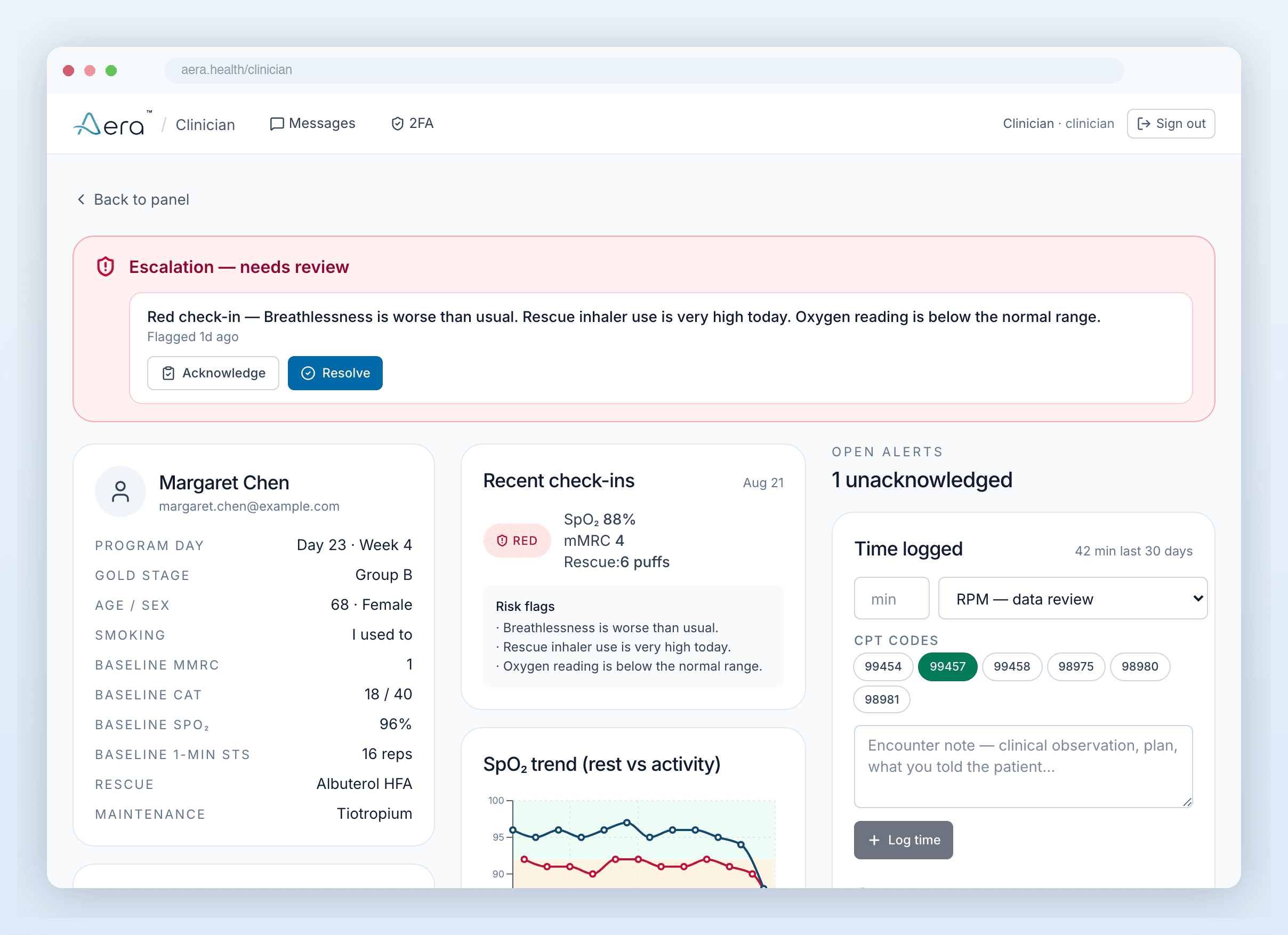
A patient summary, SpO₂ and dyspnea trends, escalation alerts, and a review timer for Remote Therapeutic Monitoring — organized so changes are easy to spot at a glance.
Your workflow
Your team reviews routine check-ins before they reach you.
Many remote-monitoring tools fill clinicians’ inboxes with low-value alerts that still carry liability. Aera is designed to bring forward only the items that need a clinician’s attention.
Your team triages first
Your nurse or RT reviews and clears routine check-ins. You step in for the escalations that genuinely need a clinician.
Fewer, more meaningful alerts
Aera is designed so that most days generate no alerts. Alerts are reserved for meaningful changes, and each one states its reason — for example, “mMRC increased from baseline + rescue overuse.”
Context at a glance
A flagged day shows the patient context, the trend, and the specific trigger together, so reviewing even a red-tier alert does not require digging through the chart.
You review on your schedule
Open alerts are collected in one place. Aera does not require a real-time response from you; you decide what is urgent and when to act.
Separate triage and closure
“Acknowledge” marks an alert as triaged; “Resolve” closes it. Keeping the two steps separate helps ensure that nothing falls through the cracks.
You stay the decision-maker
Aera organizes information and surfaces changes. Every clinical decision — and the responsibility for it — remains yours.
Reimbursement
Documentation captured as the work happens.
A timer records review time as it happens, and data days, interactive communication, and consent are recorded for each 30-day period.
Aera supports documentation for one pathway: RTM (Remote Therapeutic Monitoring). Readings that patients enter themselves count toward the data days, so the pathway does not depend on a connected device. Each 30-day period closes with its own supporting records: the qualifying data days, the review time your team actually spent, the interactive communication, the patient’s consent, and the order.
RTM, including manual entry
Remote Therapeutic Monitoring
CPT 98975 · 98984 · 98976 · 98979 · 98980 · 98981
CPT codes are listed for reference. Coverage, documentation requirements, and payment vary by payer and setting — confirm eligibility and billing rules for your program. Aera supports RTM documentation. Medicare does not cover pulmonary rehabilitation delivered in the home, and Aera does not bill pulmonary rehabilitation codes.
Designed for older adults, to help your patients stay with the program.
Large text, one question per screen, a “Read this to me” voice option, and family-assisted setup are designed so that older patients are not struggling with the technology. The data you review is useful only if patients keep using the program, so ease of use is a core design requirement rather than an afterthought.
Referrals
Refer a patient in about two minutes.
A short form asks only for your name, your practice, and the best number to reach your office. We call you back and handle the next steps.
The form collects no information about your patient: no names, dates of birth, or clinical details. Your office controls what is shared and when.
Clinical oversight
You stay informed and in control.
Aera is designed to support — never replace — the clinical relationship. Your patients’ progress is organized so your team can review it, and you remain responsible for all treatment decisions.
Aera is an educational and supportive program. It is not a medical device and does not diagnose, treat, or make clinical decisions.
Evaluating Aera for a program or health system? See guideline alignment, outcome measures, and our security posture.
Bring Aera to your patients.
See the program and how clinician oversight works.